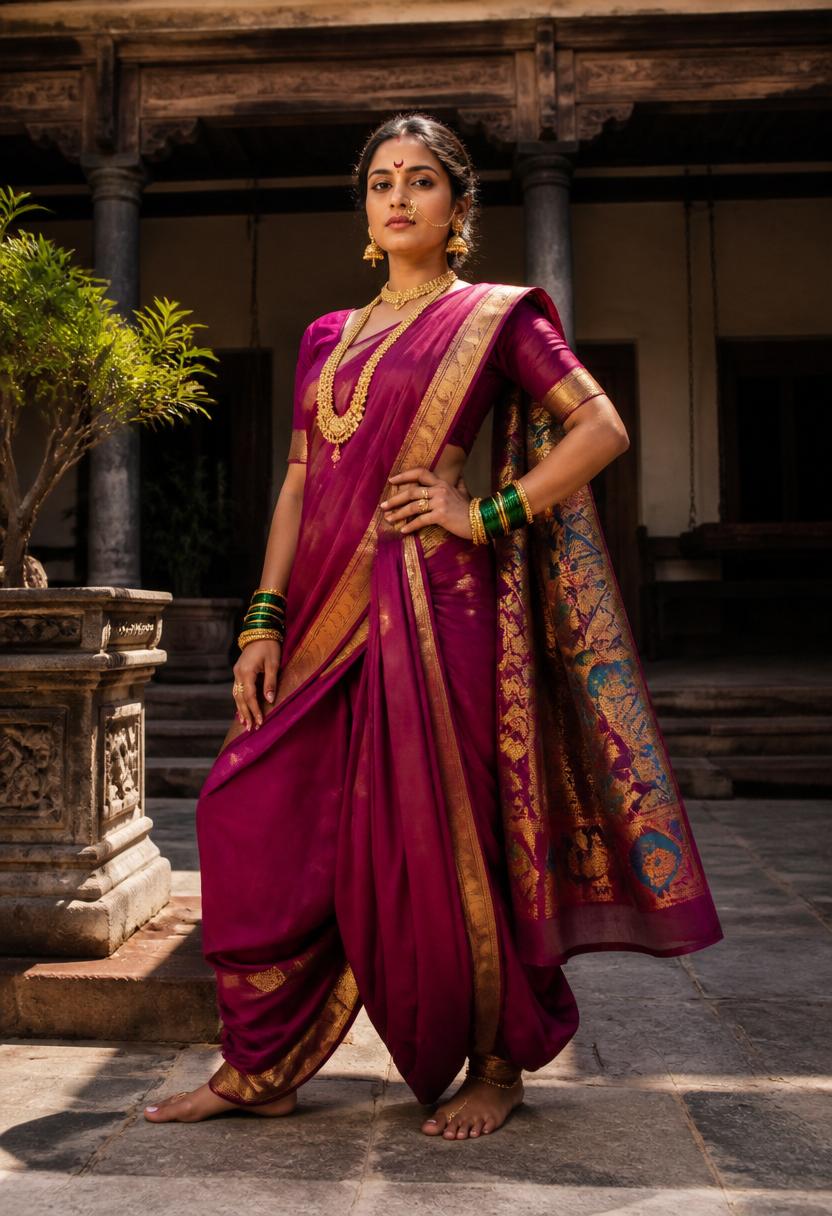
Maharashtrian wedding
The Nauvari nine-yard
A nine-yard kashta saree worn dhoti-style — fluid movement for warrior queens and wedding rituals alike.
- Drape time
- 30–40 min
- Help
- Stylist recommended
- Yardage
- 9 yd
Comfort scale
5/5
Occasion
Fabric
Body style
Stylist note · The dhoti loop needs hip definition — most flattering on regular and plus-size silhouettes.
You will need
Before you begin
- ·True nine-yard Paithani or Maharashtrian silk — six-yard sarees cannot complete the dhoti loop
- ·Cycling shorts or fitted churidar under the saree instead of a petticoat
- ·Closed-toe block heel (Nauvari is built for ritual movement, not stilettos)
- ·12 medium safety pins and 2 invisible saree pins
- ·A second pair of hands — the dhoti loop cannot be self-set on the first attempt
Pre-drape prep
- 1.Steam the Paithani on the silk setting the night before; never iron over the temple-border motifs.
- 2.Wear the shorts or churidar snug — the dhoti loop pulls fabric tight between the legs and loose underwear will be visible.
- 3.Pre-tie a practice run if this is your first Nauvari — the dhoti loop is unintuitive.
- 4.Identify the centre of the saree by folding lengthwise; centre is where the first knot ties.
Step-by-step
4 steps
Step 1 of 4
Use a true nine-yard saree — six yards will not finish the dhoti loop.
Step 2 of 4
Tie the centre at the waist; pass one half between the legs and tuck behind.
Step 3 of 4
Pleat the front piece tight and tuck above the navel.
Step 4 of 4
Drape the remaining pallu over the left shoulder, kashta-style.
Pleat & pallu anatomy
Why the drape sits the way it does
Nauvari is the warrior-queen drape of Maharashtra: nine yards worn dhoti-style. The saree's centre is tied at the waist; one half passes between the legs and tucks behind to form pant-like dhoti pleats; the other half pleats at the front and the pallu drapes over the left shoulder kashta-style. The dhoti loop frees the legs for movement — historically for horseback, today for Ganesh Chaturthi processions and Lavani performance.
Fabric note
Choosing the right cloth
True nine-yard Paithani with temple-border motifs is the heritage choice; pure Maharashtrian silk (without Paithani's brocade) works for everyday Nauvari. Avoid six-yard sarees — the dhoti loop literally cannot complete without the full nine yards. Soft, fluid silks drape best; stiff silks bunch awkwardly at the leg.
Blouse pairing
Neckline · sleeve · lining
Contrast Paithani-brocade blouse with short or cap sleeves and a round neck. Avoid backless cuts — Nauvari covers the back fully and a bare back breaks the warrior silhouette. The blouse should not extend past mid-bicep; Nauvari is built for visible, free arms.
Jewellery & finish
The last layer
Nath, chandrakor bindi, thushi necklace and kolhapuri saaj.
Hair & makeup register
The full silhouette
Centre-parted hair with a low traditional ambada bun and fresh mogra. Chandrakor bindi (crescent-moon shape) at the centre forehead is non-negotiable for ceremonial Nauvari. Defined kohl, a deep red lip, no shimmer — the look is grounded and historic.
By silhouette
Stylist-curated for every body
petite
Shorten the front pleat fan to five pleats and ask for a lighter Paithani; the dhoti loop on petite frames can look bulky in heavy silk.
regular
The classic seven-pleat fan with a full dhoti loop reads beautifully.
Plus-size
Nauvari is exceptionally flattering — the dhoti silhouette elongates and the pallu drapes cleanly. Add one extra pleat at the front for vertical line and keep the dhoti loop loose for movement.
Troubleshooting
If something slips
Dhoti loop too tight at the thighs
Re-do the back tuck looser; the loop should allow a full stride without pulling.
Front pleats sliding out during dance
Pin through the petticoat-shorts waistband — never through the silk alone; Nauvari is built for movement and unpinned pleats will not survive Lavani footwork.
Pallu falling off the left shoulder
Pin the kashta pallu directly to the blouse strap at two points — at the shoulder seam and at the bust line.
Centre knot showing at the waist
Tuck the knot's loose tail into the back dhoti pleats; the front should read smooth.
Common mistakes
What not to do
- Using a six-yard saree — Nauvari is impossible without the full nine yards.
- Wearing a petticoat instead of shorts or churidar — visible at the dhoti loop.
- Skipping the chandrakor bindi — breaks the visual tradition.
- Tying the centre knot loose — the entire drape unravels mid-event.
Care after wearing
So the saree lasts
- ·Air on a wooden hanger after wearing; never fold while damp from perspiration.
- ·Dry-clean only with a Paithani-trained cleaner; standard dry-cleaning damages the temple-border zari.
- ·Wrap in mulmul cotton for storage — never plastic.
- ·Re-fold along different creases each year to prevent zari fatigue at the same fold line.
Stylist's final check
Before the mirror
- Centre knot at the waist is firm — pull gently; the saree does not slip.
- Dhoti loop allows a full stride without pulling at the thighs.
- Front pleats are seven to nine, centred and falling cleanly to the floor.
- Pallu sits over the left shoulder, kashta-style, falling to mid-back.
- Chandrakor bindi is centred, mogra is fresh, the silhouette reads warrior-queen.