Durga Puja
The Bengali Atpoure
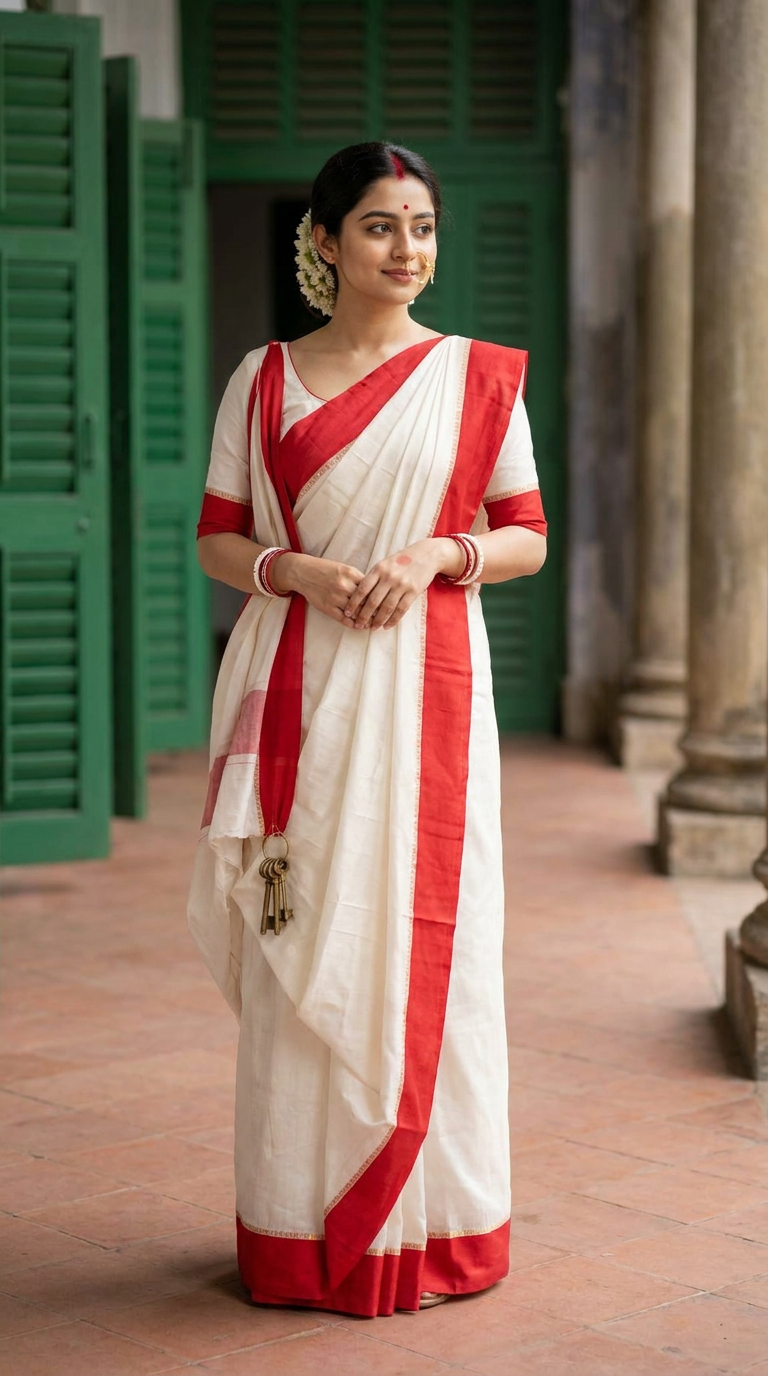
The signature Pujo drape — pleatless, with the pallu looped twice and a bunch of household keys hung from the free end.
- Drape time
- 10–12 min
- Help
- Solo
- Yardage
- 6 yd
Comfort scale
3/5
Occasion
Fabric
Body style
Stylist note · Pleatless drape skims wider hips beautifully. Petites can keep proportions by choosing a narrow-border garad.
You will need
Before you begin
- ·White or off-white cotton petticoat with drawstring
- ·Flat sandals or low block heels — Atpoure is built for walking puja-to-puja
- ·4 small safety pins, 1 invisible pin for the second pallu loop
- ·A bunch of chaabir guchcho (decorative keys) for the pallu's free end — traditional and grounding
- ·Conch-and-coral shankha-pola bangles, set ready before the drape
Pre-drape prep
- 1.Lightly starch garad cotton; tant silk does not need starch.
- 2.Iron the red border crisp; that's the line that frames the entire silhouette.
- 3.Tie the petticoat just above the navel — Atpoure sits higher than Nivi.
- 4.Set the keys on a red ribbon before draping; tying mid-drape is awkward.
Step-by-step
4 steps
Step 1 of 4
Skip the petticoat pleats — wrap the saree from right to left without front pleats.
Step 2 of 4
Bring the pallu around the back and forward over the left shoulder.
Step 3 of 4
Pass the pallu loosely under the right arm and drape it again over the left.
Step 4 of 4
Anchor a bunch of chaabir guchcho (keys) at the pallu's free end.
Pleat & pallu anatomy
Why the drape sits the way it does
Atpoure is the signature pleatless drape of Bengal: no front pleats, no fan, no centre tuck. The saree wraps right-to-left, the pallu loops twice — once around the back to the left shoulder, then under the right arm and back across to the left again — and the free end carries the household keys. The double loop is the whole identity; a single loop is everyday, the double loop is Pujo.
Fabric note
Choosing the right cloth
Garad cotton with a deep red border for Ashtami; tant silk for Navami and Dashami; pure Baluchari for evenings. Avoid heavy Kanjivaram — Atpoure relies on fluid drape, not engineered structure. Slightly stiff fabrics fan unnaturally at the second loop.
Blouse pairing
Neckline · sleeve · lining
Red cotton with three-quarter sleeves and a round neck is the classic Pujo blouse. Avoid backless or halter cuts — Atpoure covers the back fully and the blouse should match that modesty. Line cotton with mulmul; Kolkata Pujo runs long and humid.
Jewellery & finish
The last layer
Shankha-pola bangles, sindoor, and a wide gold haar.
Hair & makeup register
The full silhouette
Centre-parted hair with a low bun and a red bindi at the parting (alta optional on the feet for Sandhi Puja). Sindoor at the parting if married, kohl-rimmed eyes, a bold red lip. Atpoure carries a heavier register than southern drapes.
By silhouette
Stylist-curated for every body
petite
Shorten the second pallu loop so the keys hang at hip-level, not knee.
regular
The classic double loop with keys at mid-thigh reads beautifully.
Plus-size
Atpoure is exceptionally flattering — the pleatless wrap creates a clean vertical. Keep the pallu loops loose, not snug, for movement.
Troubleshooting
If something slips
Front of saree bunching without pleats
Re-wrap tighter at the right hip; Atpoure relies on wrap tension, not pleats, to stay smooth.
Second pallu loop falling off the shoulder
Pin invisibly at the back where the two loops cross; one pin, never visible.
Keys feeling heavy on the pallu
Reduce to three keys on the red ribbon; tradition is symbolic, not literal.
Red border twisting at the wrap
Re-fold so the border faces outward at every wrap; the border is the visual line.
Common mistakes
What not to do
- Pleating at the front out of Nivi habit — Atpoure is pleatless by definition.
- Single loop only — that's daily wear, not Pujo. Double loop is the festival drape.
- Skipping the keys — even one symbolic key is part of the visual tradition.
- Wearing the saree right-to-left like Nivi — Atpoure wraps the opposite direction.
Care after wearing
So the saree lasts
- ·Hand-wash garad and tant in cold water; never wring.
- ·Line-dry in shade so the red border does not bleed onto the white body.
- ·Iron damp to set the border crisp.
- ·Store folded with the red border on the outside fold; protects the colour.
Stylist's final check
Before the mirror
- No pleats at the front — the saree wraps smoothly across the waist.
- Pallu loops twice — once over the left shoulder, once under the right arm and back.
- Keys hang from the free end at mid-thigh.
- Red border reads as a continuous line from hem to pallu edge.
- Sindoor and bindi are in place; the look is grounded and ceremonial.