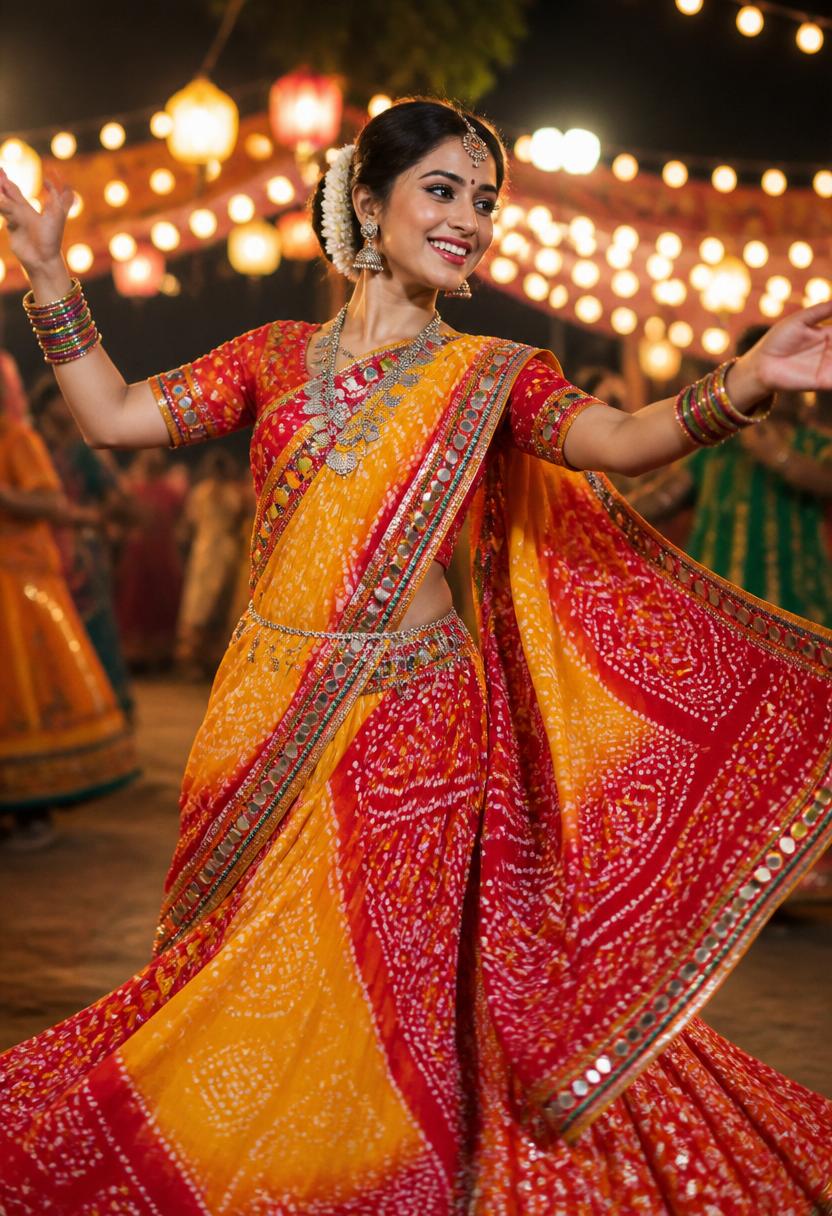
Navratri · Garba
The Gujarati Seedha Pallu
The reverse-pallu drape that lets bandhani, patola or mirror-worked pallus read clearly across the chest.
- Drape time
- 10–12 min
- Help
- Solo
- Yardage
- 6 yd
Comfort scale
3/5
Occasion
Fabric
Body style
Stylist note · Front-facing pallu draws the eye up — universally flattering across silhouettes.
You will need
Before you begin
- ·Cotton or satin petticoat in a shade close to the saree base
- ·Closed-toe pumps or kolhapuris — Seedha Pallu is built for Garba movement
- ·6 small safety pins and 1 invisible saree pin
- ·1 decorative brooch for the right shoulder
- ·Smoothing slip — bandhani is often slightly sheer at the midriff
Pre-drape prep
- 1.Lightly steam patola or gajji silk; never iron over bandhani knots (they flatten the dots).
- 2.Tie the petticoat snug at the natural waist; Seedha Pallu sits at Nivi-height.
- 3.Identify the pallu side — that's the end with the heaviest motif work; it must face forward.
- 4.Pre-fit the blouse so the right shoulder seam can take the brooch cleanly.
Step-by-step
4 steps
Step 1 of 4
Pleat at the front as usual, but turn the pallu the opposite way.
Step 2 of 4
Take the pallu from back to front over the right shoulder.
Step 3 of 4
Spread it wide across the chest so the mirror work or bootis read clearly.
Step 4 of 4
Pin once at the right shoulder; secure the loose corner at the left waist.
Pleat & pallu anatomy
Why the drape sits the way it does
Seedha Pallu (literally 'straight pallu') inverts the Nivi direction: instead of coming back-to-front over the left shoulder, the pallu comes from back-to-front over the right shoulder and spreads wide across the chest. The point is presentation — bandhani, patola or mirror-worked pallus need to read forward, not drape sideways. Front pleats are standard Nivi; only the pallu reverses.
Fabric note
Choosing the right cloth
Bandhani, patola, gajji silk or any saree whose pallu deserves the spotlight — Gharchola, mirror-worked Kutchi silks, Rajasthani leheriya. Avoid plain-bodied sarees with no pallu motif; the whole point of Seedha is to showcase the pallu's design. Stiff brocades work; very soft chiffons will sag at the wide chest spread.
Blouse pairing
Neckline · sleeve · lining
Mirror-worked, contrast bandhani or zardozi blouse — the blouse and pallu together carry the festive register. Round neck or sweetheart cut; avoid backless because Seedha Pallu covers the back through the cross-wrap. Three-quarter sleeves with mirror trim are the Navratri classic.
Jewellery & finish
The last layer
Chooda bangles, jadau choker and a maang tikka.
Hair & makeup register
The full silhouette
Centre or side-parted with a low bun and a chunky maang tikka. Defined kohl, a bold red or magenta lip, and chooda or jadau bangles stacked thick on both wrists. Navratri register is bright and unapologetic; Pujo restraint does not apply here.
By silhouette
Stylist-curated for every body
petite
Narrow the chest spread of the pallu so it doesn't dominate the silhouette; pin closer to the right shoulder.
regular
The classic full-chest spread with the pallu pinned at the right shoulder reads beautifully.
Plus-size
Seedha Pallu is exceptionally flattering on plus-size frames — the wide chest panel breaks the vertical and the right-shoulder pin draws the eye up. Use the full pallu spread.
Troubleshooting
If something slips
Pallu spread sagging at the centre chest
Pin invisibly at the centre bust line through the pallu and blouse seam — invisible from front.
Front pleats slipping out during Garba
Pin through the petticoat drawstring channel; bandhani slips on a smooth petticoat without grip.
Loose corner at left waist coming undone
Tuck deeper into the petticoat waistband and add one safety pin at the inner left hip.
Bandhani knots catching on bangles
Stack heavier bangles on the left wrist; the right wrist (pallu side) should stay lighter.
Common mistakes
What not to do
- Letting the pallu come over the left shoulder — that's Nivi, not Seedha.
- Choosing a plain-pallu saree — Seedha exists to showcase pallu motifs.
- Skipping the brooch — the right shoulder pin is structural, not just decorative.
- Pinning through a bandhani knot — flattens the dot permanently.
Care after wearing
So the saree lasts
- ·Hand-wash bandhani in cold water without wringing; the tie-dye knots reset their shape when air-dried.
- ·Dry-clean patola only with a Gujarati-trained cleaner; standard dry-cleaning bleeds the dye.
- ·Never fold along the pallu motifs — fold along the body to protect the heaviest design work.
- ·Store wrapped in mulmul cotton; bandhani survives well with breathable storage.
Stylist's final check
Before the mirror
- Pallu comes from the back over the right shoulder, spread wide across the chest.
- Front pleats are five to seven, centred and Nivi-style.
- Brooch sits cleanly on the right shoulder seam, not the chest.
- Bandhani knots or mirror work read upright and frontward.
- Loose corner at the left waist is tucked invisibly.