Tamil Iyer · Iyengar
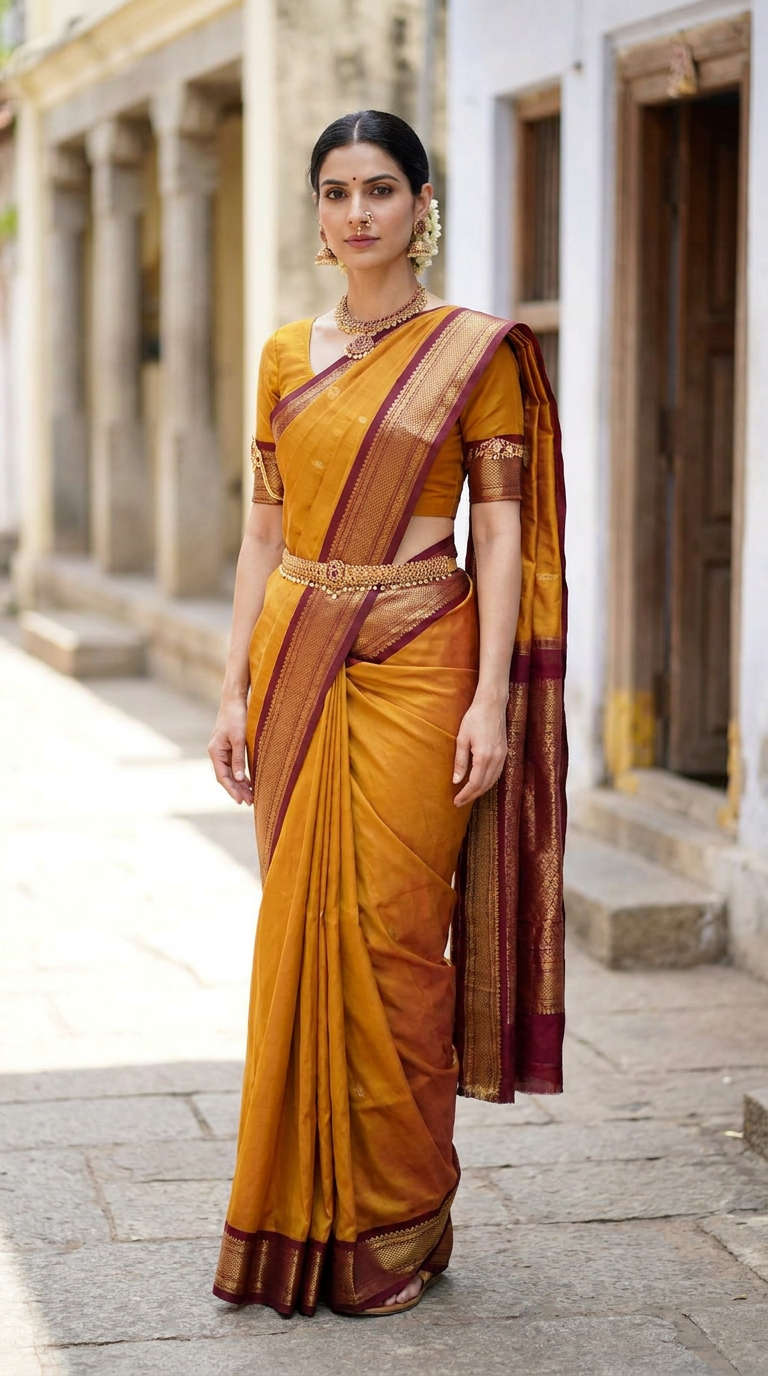
The Madisar nine-yard
The ceremonial Tamil Brahmin drape — pleated and pinned dhoti-style — worn for weddings, seemantham and the first day a girl steps into womanhood.
- Drape time
- 35–45 min
- Help
- Stylist recommended
- Yardage
- 9 yd
Comfort scale
5/5
Occasion
Fabric
Body style
Stylist note · Nine-yard volume reads richest on regular and plus-size silhouettes; petites can ask for an eight-yard alternative.
You will need
Before you begin
- ·True nine-yard Arani or Kanchipuram silk — six-yard sarees cannot complete the back loop
- ·Fitted bicycle shorts under the saree instead of a petticoat (madisar is dhoti-style)
- ·Closed-toe flats or low traditional sandals; madisar walks long distances at temples
- ·14 medium safety pins, 2 invisible saree pins, 1 decorative pin
- ·A second pair of hands; the dhoti-loop tuck cannot be self-set on first wear
Pre-drape prep
- 1.Steam the silk on the silk setting; never iron the pallu motifs directly.
- 2.Wear the shorts snug — visible underwear at the dhoti loop is a common first-wear mistake.
- 3.Identify whether the household is Iyer (right-hip knot) or Iyengar (left-hip knot); the direction is non-negotiable.
- 4.Lay the saree out lengthwise to identify the centre — the centre wraps the waist twice before the dhoti loop begins.
Step-by-step
4 steps
Step 1 of 4
Drape one end around the waist twice; tie a firm knot at the right hip (Iyer style — Iyengars knot at the left).
Step 2 of 4
Pass the remaining length between the legs and tuck behind at the centre-back to form the dhoti.
Step 3 of 4
Pleat the front piece into 7–9 narrow pleats; tuck centred at the navel.
Step 4 of 4
Bring the pallu around the back, over the left shoulder; pin to the blouse.
Source reference
- Madisar draping — The Hindu, 'Nine yards of tradition' (2019 feature on Iyer and Iyengar variations)
- Reviewed against Kalakshetra Foundation ceremonial drape notes
Pleat & pallu anatomy
Why the drape sits the way it does
Madisar is the ceremonial nine-yard drape of Tamil Brahmin women. The saree wraps the waist twice, ties a firm knot at the right hip (Iyer) or left hip (Iyengar), passes the remaining length between the legs to form a dhoti tucked at the centre-back, and ends with 7–9 narrow front pleats and a pallu over the left shoulder. The Iyer-vs-Iyengar knot direction is the single most important community-marker in the drape.
Fabric note
Choosing the right cloth
Nine-yard Arani or Kanchipuram silk is the classic; Maharani Madisars in pure silk with broad zari borders for weddings; lighter cotton-silk for daily ceremonial wear. Avoid heavy six-yard Kanjivaram — madisar requires the full nine yards to complete the back loop. The pallu motif should be motif-heavy; it's photographed at every ritual.
Blouse pairing
Neckline · sleeve · lining
Short-sleeved contrast silk blouse with the traditional U-neck or modest sweetheart cut. Avoid backless or halter — madisar is ceremonial and demands full coverage. Line the blouse in cotton; weddings and seemanthams run six hours and the silk-on-silk friction without lining causes rashes.
Jewellery & finish
The last layer
Vanki, oddiyanam, jhumkis and a long muthu mala of pearls.
Hair & makeup register
The full silhouette
Centre-parted hair with a low jada or chignon, mallipoo (jasmine) strung tight, and traditional Tamil temple jewellery — vanki on the upper arm, oddiyanam at the waist, jhumkis, a long muthu mala. Kumkum at the parting, defined kohl, a deep red lip. Madisar is ceremonial register only.
By silhouette
Stylist-curated for every body
petite
Reduce front pleats to five and ask for a lighter weave; madisar's dhoti loop can overwhelm petite frames in heavy silk.
regular
The classic seven-pleat fan with the full dhoti loop reads beautifully.
Plus-size
Madisar is exceptionally flattering on plus-size frames — the dhoti loop elongates and the pallu over the left shoulder draws the eye up. Keep the dhoti loop loose for movement and use the full nine pleats.
Troubleshooting
If something slips
Hip knot loosening during a long ceremony
Re-tie with a double knot; madisar's hip knot is structural, not decorative.
Dhoti loop pulling too tight at the back
Re-tuck looser at centre-back; you should be able to sit cross-legged comfortably.
Front pleats slipping during temple walks
Pin through the shorts' waistband — never through the silk alone.
Pallu drooping off the left shoulder
Pin the pallu at two points — shoulder seam and bust line — and tighten the hip knot, which often controls pallu tension.
Common mistakes
What not to do
- Wrong hip knot direction — Iyer ties right, Iyengar ties left; mixing is a visible community gaffe.
- Using a six-yard saree — physically impossible to complete madisar's back loop.
- Wearing a petticoat instead of shorts — visible at the dhoti loop, instantly wrong.
- Skipping the centre-back tuck — the dhoti loop collapses and the saree wraps like a skirt.
Care after wearing
So the saree lasts
- ·Air on a wooden hanger after the ceremony; never fold while damp from perspiration.
- ·Dry-clean only with a Kanjivaram-trained cleaner familiar with nine-yard sarees.
- ·Wrap in mulmul cotton for storage — never plastic, never tissue paper (the acid tarnishes zari).
- ·Re-fold along different creases each year so the zari does not weaken at the same fold.
Stylist's final check
Before the mirror
- Hip knot is on the correct side for the household (Iyer right, Iyengar left).
- Dhoti loop allows seated cross-legged posture without pulling.
- Front pleats are seven to nine, centred and crisp.
- Pallu sits over the left shoulder, pinned at two points, falling to mid-back.
- Mallipoo, vanki, oddiyanam are all in place; the silhouette reads ceremonial.