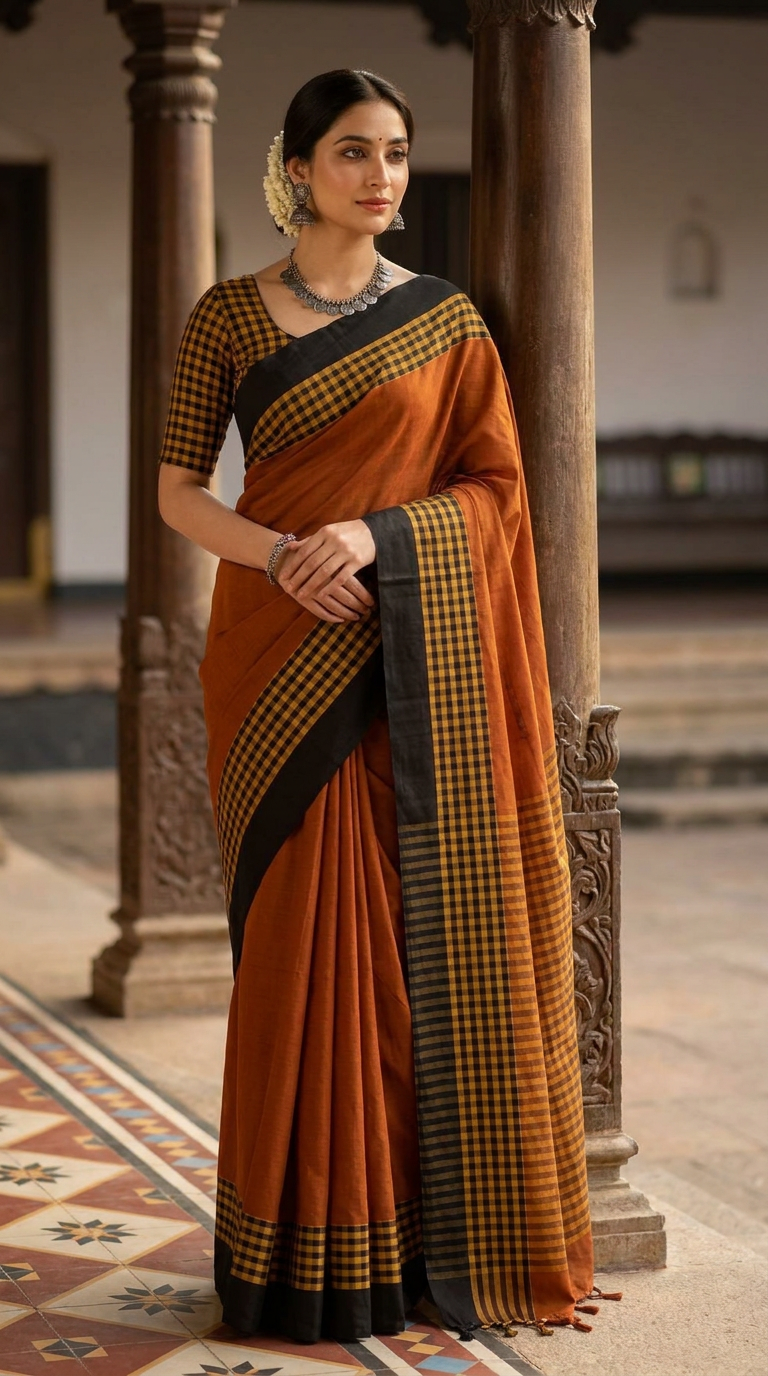
Tamil everyday
The Pinkosu reverse pleat
The everyday Tamil and Karnataka drape — pleats fall down the back instead of the front, freeing the legs for kitchen and farm work.
- Drape time
- 4–6 min
- Help
- Solo
- Yardage
- 6 yd
Comfort scale
1/5
Occasion
Fabric
Body style
Stylist note · Back pleats free the front line — comfortable on every body, especially flattering for plus-size.
You will need
Before you begin
- ·Cotton drawstring petticoat in any neutral shade
- ·Flat sandals or kolhapuris — pinkosu is a working drape
- ·2 small safety pins (one for the back tuck, one for the pallu tip)
- ·A waist-coin pouch or key-belt if you intend to work in it
Pre-drape prep
- 1.Lightly starch the cotton the day before — pinkosu falls best on fabric that has a little memory.
- 2.Iron pleats flat at the back fold before draping; the pleats stack faster.
- 3.Wear the petticoat 2 inches below the navel — pinkosu sits lower than Nivi.
Step-by-step
4 steps
Step 1 of 4
Start at the right hip; take a full turn around the waist.
Step 2 of 4
Form 7–10 pleats at the back with the open edge facing downward; tuck them centred behind the waist.
Step 3 of 4
Bring the second half across the front and over the left shoulder.
Step 4 of 4
Let the pallu fall long, or tuck the tip into the waist for free hands.
Source reference
- Pinkosu/pinkoshu reverse-pleat drape — Tamil Nadu rural-style documentation, Sahapedia 'Everyday saris of the South' (2020)
- Verified with senior weavers in Chettinad on downward-facing back pleats
Pleat & pallu anatomy
Why the drape sits the way it does
Pinkosu inverts the standard Nivi logic: pleats fall down the back like a fan, not the front. That keeps the front clean and the legs unbound for kitchen, fieldwork or temple steps. The pallu can be left long for evening visits or tucked at the right waist for full-handed work.
Fabric note
Choosing the right cloth
Soft Chettinad cotton, Kalakshetra weave or fine handloom mulmul behave best — fabrics that fall, not stand. Avoid stiff cottons and any organza; pinkosu needs the pleats to drift, not architect themselves.
Blouse pairing
Neckline · sleeve · lining
An elbow-sleeve cotton blouse with a square or modest U-neck. Pinkosu is a working drape — the blouse should breathe. Avoid backless or halter cuts; this is daily wear, not occasion wear.
Jewellery & finish
The last layer
Daily-wear thali, gold studs, glass bangles.
Hair & makeup register
The full silhouette
A single oiled braid with jasmine or a simple low knot. Makeup is minimal — a swipe of kohl, kumkum at the parting; pinkosu is rarely styled for camera.
By silhouette
Stylist-curated for every body
petite
Reduce to 5–6 back pleats so the fan does not overwhelm the silhouette.
regular
The standard 7–10 pleats fall cleanly; let the pallu reach mid-thigh.
Plus-size
Pinkosu is exceptionally flattering — the back pleats lift the line. Use the full 10 pleats and let the pallu fall long.
Troubleshooting
If something slips
Back pleats fanning up instead of down
Re-fold each pleat with the open edge facing the floor; the fold direction is what makes pinkosu read correctly.
Pleats slipping out during work
Add one safety pin through the centre back tuck and the petticoat waistband — invisible from front.
Pallu falling forward when you bend
Tuck the pallu tip into the waist at the right side; this is the traditional working position.
Saree riding up at the ankle
Re-tuck at the petticoat 1 cm lower; pinkosu sits lower than Nivi by design.
Common mistakes
What not to do
- Pleating at the front out of habit — that is Nivi, not pinkosu.
- Pleats with the open edge facing up — fabric collects sweat and looks unfinished.
- Wearing pinkosu with a heavy zari saree — the drape was built for daily cotton.
- Adding a brooch at the shoulder; pinkosu is unpinned at the pallu by tradition.
Care after wearing
So the saree lasts
- ·Hand-wash in cold water with a mild detergent; machine wash on a delicate cycle only with a mesh bag.
- ·Line-dry in shade so the dye does not fade.
- ·Iron the pleats while still slightly damp — sets the fall.
- ·Store folded along its natural creases; cotton tolerates repeat folding better than silk.
Stylist's final check
Before the mirror
- Back pleats are stacked downward and centred.
- Front of the saree is smooth — no front pleats visible.
- Pallu sits on the left shoulder, neither pinned nor knotted.
- Hem clears the ankle so you can walk freely.
- Petticoat does not peek at the waistline.