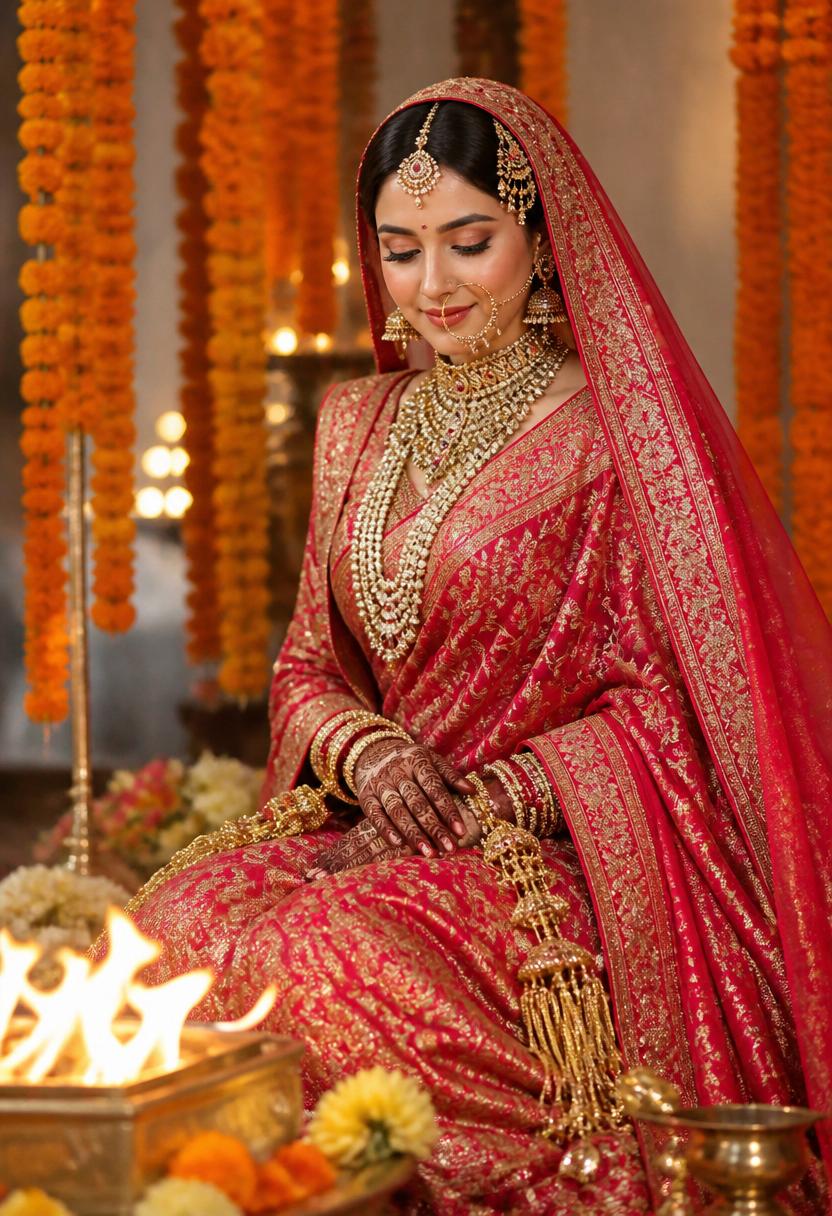
North Indian bridal
The Seedha Pallu bridal veil
The North Indian bridal interpretation of Seedha Pallu — pallu pulled forward and over the head as a soft veil for the pheras.
- Drape time
- 30–40 min
- Help
- Stylist recommended
- Yardage
- 9 yd
Comfort scale
5/5
Occasion
Fabric
Body style
Stylist note · Head-veil pulls focus upward — flattering across silhouettes. Petites should keep the veil length below the elbow only.
You will need
Before you begin
- ·9 yd Banarasi tissue or kadhwa silk — 6 yd cannot complete both Seedha and the veil
- ·Heavy zardozi long-sleeve blouse with high neck
- ·Polki bridal set: maang tikka, nath, sheeshphool, raani haar, chooda
- ·16 invisible pins, 4 decorative pins, double-sided tape
- ·A bridal stylist or trained family member — the head veil cannot be self-set on wedding day
Pre-drape prep
- 1.Steam Banarasi tissue on silk setting; iron only the inside.
- 2.Pre-fit the long-sleeve zardozi blouse with all hooks; the bridal sleeve is tight.
- 3.Set the bridal hair (low bun with gajra) before draping; the maang tikka and sheeshphool must be in place before the veil is pinned.
- 4.Identify the pallu's embroidered end — that's what frames the face under the veil.
Step-by-step
4 steps
Step 1 of 4
Drape the saree Seedha Pallu-style with the pallu coming over the right shoulder.
Step 2 of 4
Take a long extra length of the pallu — at least a metre — toward the front.
Step 3 of 4
Bring that length up and over the head as a veil; pin behind the ear.
Step 4 of 4
Let the embroidered end fall to the left elbow to frame the face.
Pleat & pallu anatomy
Why the drape sits the way it does
Seedha Pallu bridal veil extends the standard Seedha drape by reserving an extra metre of pallu to pull forward and up over the head as a veil. The veil pins behind the ear (not at the centre crown — that's a dupatta) and lets the pallu's embroidered end fall to the left elbow to frame the face during the pheras.
Fabric note
Choosing the right cloth
Banarasi tissue and kadhwa silk are the classic choices — the zari must catch every flame from the agni. Avoid stiff brocades — the head veil requires soft drape over the hair. Deep red, maroon or wine for North Indian bridal register.
Blouse pairing
Neckline · sleeve · lining
Long-sleeved high-neck zardozi blouse; the bridal register requires full coverage. Heavy gota, polki or kundan work; backless not appropriate. Cotton-lined; pheras run 90 minutes minimum.
Jewellery & finish
The last layer
Maang tikka, nath, sheeshphool, raani haar.
Hair & makeup register
The full silhouette
Low bridal bun with gajra, maang tikka at the parting, sheeshphool extending across the forehead, nath at the left nostril. Defined kohl, deep red lip, contoured cheek with soft highlight. Polki raani haar, choker, polki earrings, chooda stacked to elbow.
By silhouette
Stylist-curated for every body
petite
Reduce the veil's fall length so the embroidered end stops at the bust, not the elbow.
regular
The classic elbow-length veil with the embroidered end framing the face reads beautifully.
Plus-size
Seedha bridal veil is exceptionally flattering — the front pallu spread, the veil's vertical line and elbow-length embroidered end all elongate.
Troubleshooting
If something slips
Veil sliding off the head during pheras
Pin behind both ears (not at the crown); the behind-ear pin is structural.
Pallu spread sagging at the front
Pin invisibly at centre bust through pallu and blouse.
Zari catching on the agni fire
Tuck the embroidered end into the lap once seated for pheras.
Sheeshphool tangling with the veil
Set sheeshphool first, then pin the veil behind it.
Common mistakes
What not to do
- Pinning the veil at the centre crown — that's a dupatta drape, not Seedha.
- Using a 6 yd saree — cannot complete both Seedha and the head veil.
- Backless or sleeveless blouse — North Indian bridal seedha requires full coverage.
- Heavy starched Banarasi — refuses to drape softly over the hair.
Care after wearing
So the saree lasts
- ·Dry-clean only with a bridal Banarasi specialist.
- ·Store wrapped in mulmul cotton, never plastic; Banarasi zari needs to breathe.
- ·Re-fold annually along a different crease.
- ·Keep silica gel sachets in storage; bridal heirlooms must avoid humidity.
Stylist's final check
Before the mirror
- Pallu comes over the right shoulder, spread wide across the chest.
- Veil rises from the pallu, pinned behind both ears.
- Embroidered end falls to the left elbow to frame the face.
- Maang tikka, sheeshphool, nath, chooda are all in place.
- Bride can sit cross-legged for pheras without the drape pulling.