Assam · Bihu
The Mekhela Chador
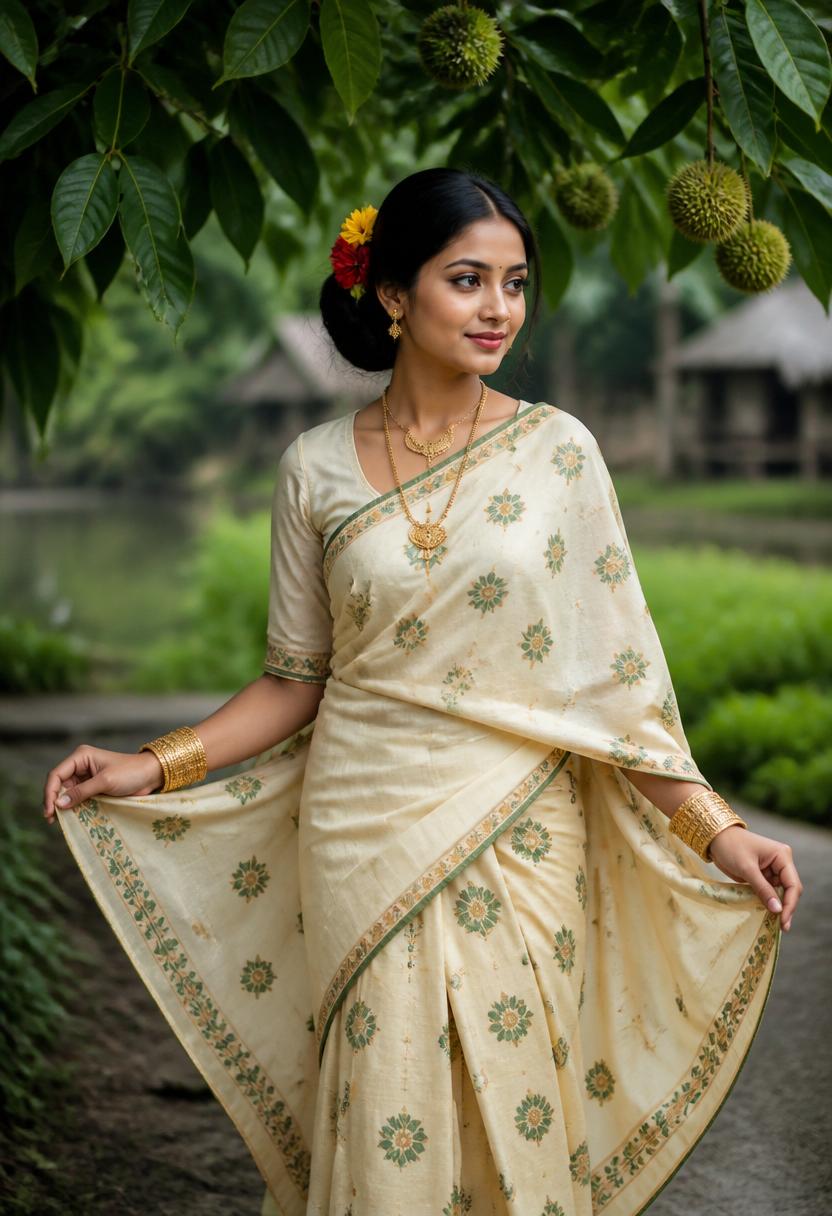
Assam's two-piece silk drape — mekhela (skirt) below, chador above — woven in golden Muga silk for Bihu and weddings.
- Drape time
- 12–15 min
- Help
- Solo
- Yardage
- Two-piece
Comfort scale
3/5
Occasion
Fabric
Body style
Stylist note · Two-piece structure can be tailored exactly to any silhouette — a stylist favourite across sizes.
You will need
Before you begin
- ·Mekhela (skirt) with a strong drawstring or hook closure
- ·Chador — the upper drape, usually 2.5 m of Muga or Pat silk
- ·Contrast red blouse with elbow sleeves
- ·6 small safety pins (three for the mekhela, three for the chador)
- ·Fresh orchid or kopou phul for the hair
Pre-drape prep
- 1.Never starch Muga silk — starching breaks the natural golden lustre.
- 2.Steam the chador on the silk setting; iron only the inside surface.
- 3.Identify the anchol — the embroidered or motif-heavy end of the chador.
- 4.Tie the mekhela's drawstring snug at the natural waist; it sits higher than a petticoat.
Step-by-step
4 steps
Step 1 of 4
Step into the mekhela; pleat at the front and tuck at the waist.
Step 2 of 4
Drape the chador around the back; bring it forward over the left shoulder.
Step 3 of 4
Tuck a triangle of the chador into the mekhela at the right waist.
Step 4 of 4
Let the embroidered end (anchol) fall to mid-back.
Pleat & pallu anatomy
Why the drape sits the way it does
Mekhela Chador is Assam's two-piece drape — the mekhela is a wide cylindrical skirt pleated at the front; the chador is a long upper cloth draped around the back, over the left shoulder, with a triangular tuck at the right waist. The anchol falls to mid-back. The drape is structurally a two-piece and never collapses into a single-piece saree silhouette.
Fabric note
Choosing the right cloth
Pure Muga silk for Bihu and weddings (the golden lustre is the entire visual signature); Pat silk for daily ceremonial wear; Eri silk for winter and modern interpretations. Never wear printed polyester mekhela chador for ceremonial occasions — it reads cheap to Assamese eyes. Muga deepens in colour with age and washing; a 20-year-old mekhela chador is the heirloom standard.
Blouse pairing
Neckline · sleeve · lining
Red Muga blouse with elbow sleeves is the Bihu classic. Round neck, modest fit. Avoid backless or halter — mekhela chador is ceremonial and demands coverage. Cotton-lined for long wear; weddings in Assam run six to eight hours.
Jewellery & finish
The last layer
Jonbiri, dholbiri, gam-kharu bangles and an orchid in the hair.
Hair & makeup register
The full silhouette
Low chignon with a fresh orchid (kopou phul) tucked behind the right ear. Defined kohl, a coral or wine lip, jonbiri (crescent pendant), dholbiri (drum-shaped earrings) and stacked gam-kharu bangles. The jewellery is uniquely Assamese; never substitute South Indian or North Indian sets.
By silhouette
Stylist-curated for every body
petite
Reduce mekhela pleats to four and keep the anchol short (to upper back); the full anchol-to-mid-back can overwhelm petite frames.
regular
The classic six-pleat mekhela with anchol falling to mid-back reads beautifully.
Plus-size
Mekhela Chador is exceptionally flattering on plus-size frames — the two-piece silhouette creates a clear waistline. Use the full eight pleats and a longer anchol to elongate.
Troubleshooting
If something slips
Chador slipping off the left shoulder
Pin invisibly at the shoulder seam and at the right-waist triangular tuck — two pin minimum.
Mekhela pleats spreading at the front
Tighten the drawstring and pin pleats together at the top of the fan.
Anchol bunching at the back
Re-drape, letting the chador fall naturally with the anchol's weight; do not pin the anchol itself.
Muga losing its lustre
Avoid steam at high heat; Muga's golden sheen is a structural protein and high heat damages it permanently.
Common mistakes
What not to do
- Starching Muga — kills the natural lustre.
- Wearing the chador like a Nivi pallu — mekhela chador is two-piece, never a single saree.
- Skipping the kopou phul or orchid — the floral hair element is part of the drape.
- Substituting North Indian or South Indian jewellery — the Assamese jonbiri set is iconic and inseparable.
Care after wearing
So the saree lasts
- ·Dry-clean Muga only with an Assam-trained cleaner; standard cleaning damages the protein fibre.
- ·Store wrapped in mulmul cotton, never plastic; Muga needs to breathe.
- ·Air the mekhela and chador separately after each wear; never pack damp.
- ·Re-fold annually along a different crease to protect the zari work.
Stylist's final check
Before the mirror
- Mekhela pleats fan from the front centre, six to eight clean folds.
- Chador drapes from back over the left shoulder, anchol falling to mid-back.
- Triangular tuck at the right waist holds the chador firm.
- Kopou phul (or orchid) sits behind the right ear.
- Jonbiri, dholbiri, gam-kharu are all in place; the silhouette reads Bihu.