Bridal · Mehendi
The Lehenga saree drape
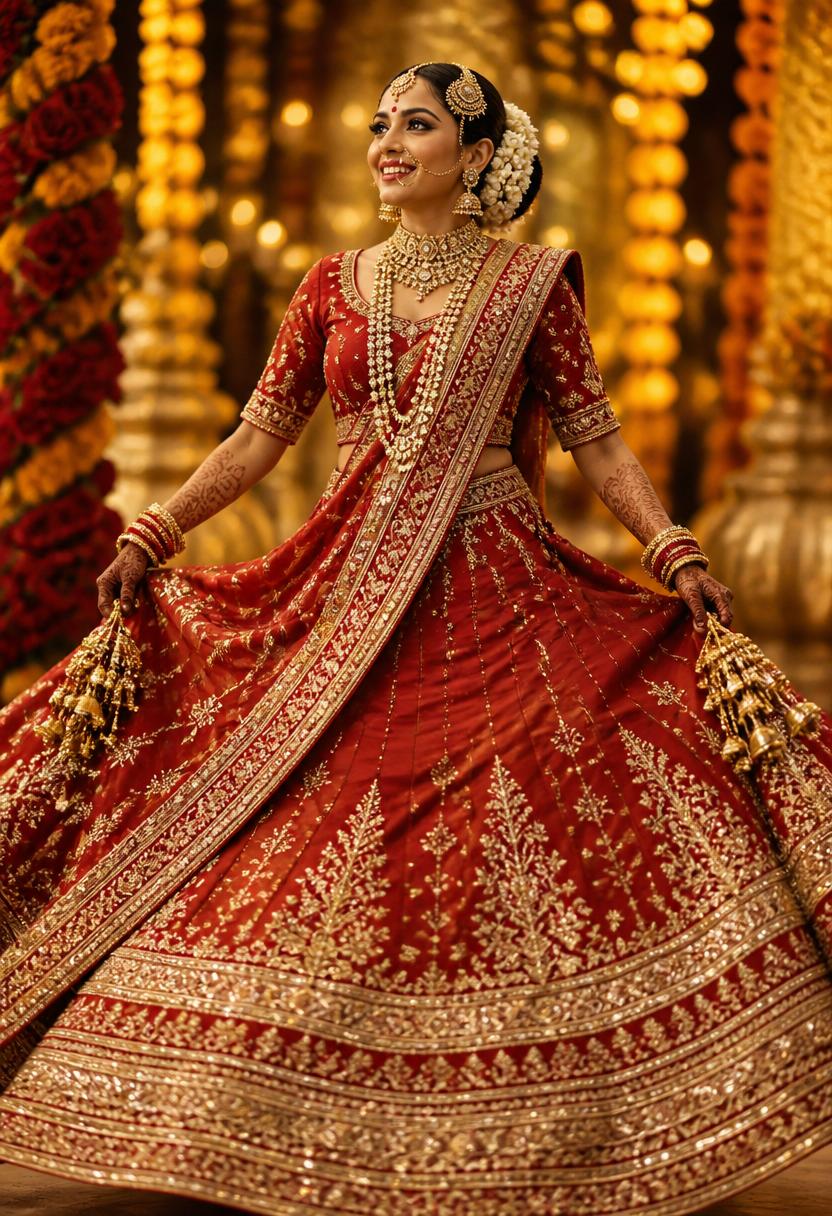
A hybrid drape that gives a lehenga's flare with a saree's pallu — perfect for brides who want movement on the dance floor.
- Drape time
- 15–18 min
- Help
- Easier with help
- Yardage
- Pre-stitched
Comfort scale
3/5
Occasion
Fabric
Body style
Stylist note · Flared skirt redistributes volume — works universally, particularly forgiving for plus-size brides.
You will need
Before you begin
- ·Circular flared underskirt — never a straight petticoat (the flare IS the silhouette)
- ·Pre-stitched lehenga saree or a 6 yd saree paired with the flared skirt
- ·Backless or halter heavily embroidered choli
- ·6 invisible pins (the drape relies on pin-and-pleat tailoring, not tucks)
- ·5 in heels — the lehenga saree is built tall and the underskirt needs height
Pre-drape prep
- 1.Steam the saree and skirt separately; never stack while hot.
- 2.Fit the flared skirt at the natural waist with a strong drawstring or zip.
- 3.Pre-fit the choli with all hooks closed and set the kamarbandh ready.
- 4.Identify the pallu motif side — the pallu pins in a long single line and must read forward.
Step-by-step
4 steps
Step 1 of 4
Wear a circular flared skirt instead of a straight petticoat.
Step 2 of 4
Tuck the saree at the right hip; take a single turn around the waist.
Step 3 of 4
Skip front pleats — let the skirt's flare carry the volume.
Step 4 of 4
Drape the pallu over the left shoulder, pinned in a long single line to the elbow.
Pleat & pallu anatomy
Why the drape sits the way it does
Lehenga saree drape eliminates front pleats and uses the flared underskirt to carry the volume. The saree wraps the waist once, no front pleating, and the pallu drapes over the left shoulder in a long unpleated line pinned to the elbow. The flare comes from the circular skirt, not the saree's pleats — that's why the saree fabric can be lighter than a traditional Nivi.
Fabric note
Choosing the right cloth
Pre-stitched lehenga sarees from a bridal designer are simplest; alternatively, any soft Banarasi, georgette or net saree paired with a matching flared underskirt. Avoid stiff Kanjivaram for this drape — the lehenga saree silhouette requires fluid fall over the skirt's flare.
Blouse pairing
Neckline · sleeve · lining
Heavily embroidered backless or halter choli — the back is exposed and the pallu pins to the shoulder. Zardozi, polki or mirror-work embroidery; long sleeves or three-quarter for bridal register.
Jewellery & finish
The last layer
Polki necklace, kaleere, kamarbandh and chooda.
Hair & makeup register
The full silhouette
Centre or side-parted with a low bridal bun or open Hollywood waves with a maang tikka. Polki necklace, kaleere on both wrists, kamarbandh at the waist, chooda stacked from wrist to elbow. Defined eye, deep red lip, contoured cheek. Full bridal register.
By silhouette
Stylist-curated for every body
petite
Choose a semi-circular skirt instead of full circular; full flare can swallow a petite frame.
regular
The classic full-circular flare with the pallu pinned to the elbow reads beautifully.
Plus-size
Lehenga saree is exceptionally flattering — flared skirt creates A-line and the pallu's vertical line elongates. Use the full circular flare and a longer pallu fall.
Troubleshooting
If something slips
Skirt visible above the saree at the waist
Tuck the saree's waist edge over the skirt's waistband; the skirt should never show at the waist.
Pallu pinning not holding the long single line
Use three invisible pins — shoulder, mid-arm, elbow — instead of just one.
Skirt and saree colour mismatching under light
Test the layering under photography lights before the function.
Kamarbandh slipping over the saree edge
Position kamarbandh directly over the saree's waist wrap, not over the skirt alone.
Common mistakes
What not to do
- Using a straight petticoat — destroys the lehenga silhouette.
- Adding front pleats — the lehenga saree is pleatless by design.
- Pinning the pallu in a single point — the long line needs three pins minimum.
- Choosing a stiff Kanjivaram — the saree fabric must flow over the skirt's flare.
Care after wearing
So the saree lasts
- ·Dry-clean only with a bridal-specialist cleaner.
- ·Hang the skirt on a padded hanger; store the saree folded with the pallu on the outside fold.
- ·Inspect kundan, polki and zardozi work after each wear.
- ·Store in a muslin bag with silica gel sachets.
Stylist's final check
Before the mirror
- Flared skirt creates a clean A-line silhouette below the waist.
- No front pleats — the silhouette is pleatless.
- Pallu sits in a long single unpleated line from left shoulder to elbow.
- Kamarbandh is positioned over the saree's waistline, not the skirt.
- Choli, kaleere, chooda, polki — full bridal register is in place.