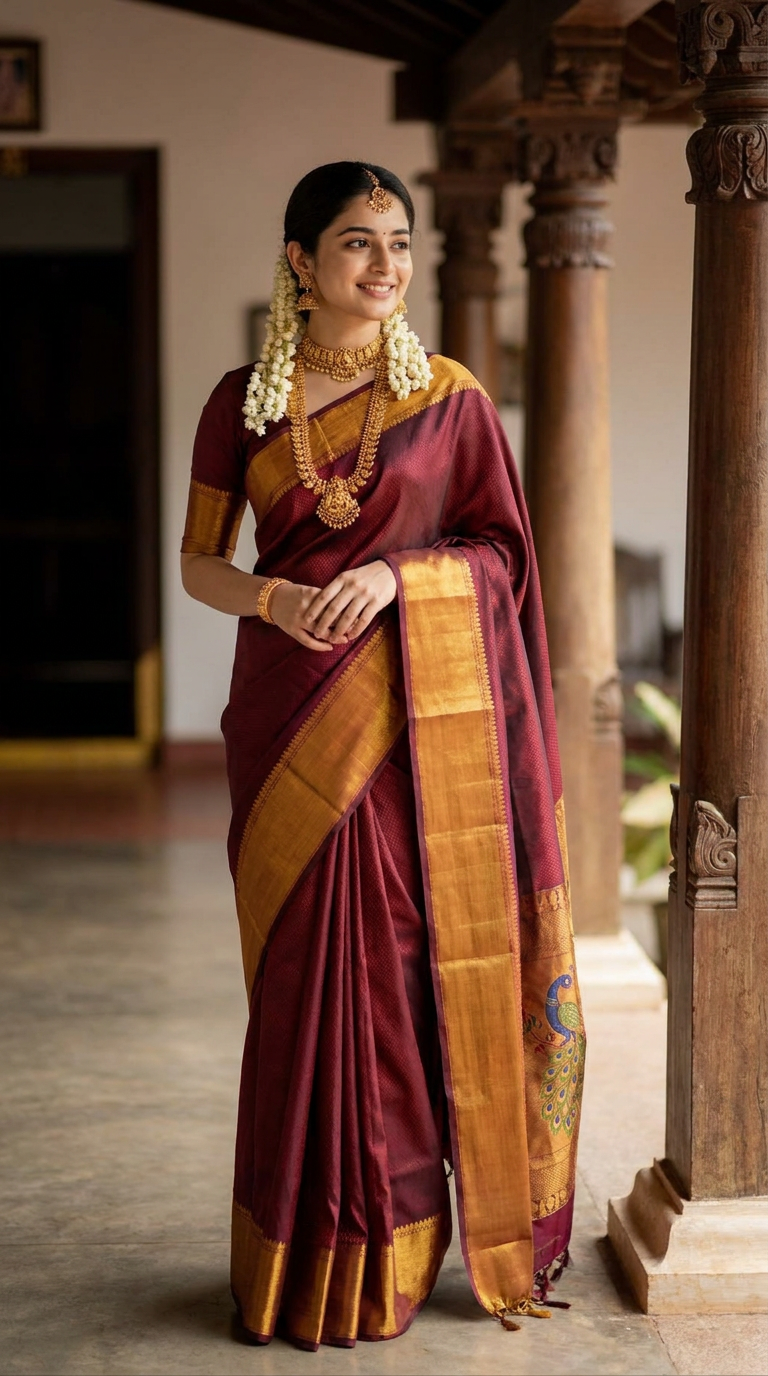
Temple bridal
The South Indian bridal Nivi (Kanjivaram)
The classic South Indian bridal drape — a heavy Kanjivaram, deep front pleats, and a fanned pallu that shows off the temple border.
- Drape time
- 25–35 min
- Help
- Stylist recommended
- Yardage
- 6 yd
Comfort scale
5/5
Occasion
Fabric
Body style
Stylist note · Heavy zari carries beautifully on regular and plus-size frames; petites should ask for a lighter Kanjivaram or fewer fan pleats to avoid bulk.
You will need
Before you begin
- ·Cotton petticoat in the saree's base colour, drawstring (not elastic), with non-slip tape sewn at the waistline
- ·Closed-toe block heel (3–4 in) so the hemline grazes the floor
- ·12–15 medium safety pins and 1 decorative saree brooch
- ·Shapewear or a smoothing camisole under the blouse for a clean torso line
- ·A second pair of hands for the fanned pallu
Pre-drape prep
- 1.Steam the saree on the silk setting the night before; never iron directly over real zari — press a muslin cloth between iron and saree.
- 2.Tie the petticoat 1–2 inches below the navel, snug enough that two fingers slide under the drawstring.
- 3.Pre-fit the blouse 30 minutes before the drape so the chest hooks settle.
- 4.Lay the saree flat and identify the pallu, body and border so the temple motifs sit upright at the shoulder.
Step-by-step
4 steps
Step 1 of 4
Anchor the plain end at the right hip — Kanjivaram silk needs a firm tuck.
Step 2 of 4
Make 7–9 deep pleats; press flat with the palm before tucking.
Step 3 of 4
Bring the pallu over the left shoulder, then fan a second layer for the temple border.
Step 4 of 4
Secure with a gold saree pin behind the shoulder so the zari sits flat.
Source reference
- South Indian bridal Nivi — Kanchipuram weavers' guild styling notes
- Cross-checked with Sruti Magazine bridal drape essays
Pleat & pallu anatomy
Why the drape sits the way it does
The drape's silhouette is built on three engineered points: a firm right-hip tuck that locks the silk, seven to nine deep front pleats that anchor the navel, and a fanned pallu — a second layer pulled forward over the first — that lets the temple border read on camera. Get the hip tuck right and the rest follows.
Fabric note
Choosing the right cloth
Pure mulberry Kanjivaram silk has real silver-gilt zari that does not bend kindly. It needs a firm petticoat with non-slip tape — elastic alone will not hold a 700 g saree. Avoid starch; the silk is already engineered to stand. Skip metal pins anywhere near the zari motifs — use them only on the body of the saree.
Blouse pairing
Neckline · sleeve · lining
A contrast brocade with a high boat neck and elbow sleeves balances the heavy border. Line the blouse in cotton so the silk does not stick to skin, and ask for hook-and-eye closures rather than zip — easier to adjust during long ceremonies. Leave at least one inch of midriff between blouse hem and pleat tuck.
Jewellery & finish
The last layer
Temple-cut gold haram, vanki, jhumkas and oddiyanam waist belt.
Hair & makeup register
The full silhouette
Centre-parted hair gathered into a low jada with jasmine and kanakambaram strands. Makeup register is matte base, defined kohl, a deep red lip — Kanjivaram silk catches every reflection, so skip shimmer below the cheekbone.
By silhouette
Stylist-curated for every body
petite
Ask for a lighter 600 g Kanjivaram and reduce the fan to five pleats so the pallu does not swallow the frame.
regular
The classic seven-pleat fan reads beautifully — keep the pallu fall just past the elbow.
Plus-size
Heavy zari sits gracefully on plus-size frames. Add one extra pleat at the front for a longer vertical line, and let the pallu fall to mid-calf for height.
Troubleshooting
If something slips
Pleats slipping out at the navel
Re-tuck through the petticoat's waistband tape, not into the petticoat fabric itself; the tape grips silk.
Pallu fan keeps collapsing
Pin the back layer to the blouse first, then the front fan separately — two pins, not one.
Temple border peeking at the wrong angle
Re-fold the pallu so the border edge sits on top, not under; the motif must read frontward.
Saree pin marks visible on the zari
Move pins to the silk body adjacent to the zari, never through the zari thread itself.
Hem dragging on the floor
Lift the pleat tuck by half an inch at the navel; do not re-fold the pleats.
Common mistakes
What not to do
- Wearing the petticoat with elastic instead of a drawstring — Kanjivaram silk slips against elastic.
- Ironing over the zari directly — the silver gilt scorches and never recovers.
- Pinning straight through a zari motif — leaves permanent puncture marks.
- Choosing a six-yard saree when the look calls for a temple-bridal fan; the fan needs the full length.
- Skipping the second pair of hands — the fanned pallu cannot be self-set.
Care after wearing
So the saree lasts
- ·Air the saree on a wooden hanger for an hour after wearing; never fold it warm.
- ·Re-fold along different creases each time to prevent zari fatigue.
- ·Store wrapped in mulmul cotton — never plastic, never tissue paper (the acidity tarnishes the zari).
- ·Dry-clean only once a year, and only with a Kanjivaram-trained cleaner who uses cold-process solvents.
Stylist's final check
Before the mirror
- Hip tuck is firm — pull the pallu gently; the saree does not move at the navel.
- Seven to nine pleats are even, centred and falling straight to the floor.
- Pallu fan opens into a clean half-circle when you raise your arm.
- Temple border reads upright at the shoulder and along the pallu edge.
- Hemline grazes the floor at the back, clears the toe at the front.